
Dealing with student loans is frustrating, but it can be even more overwhelming if you’re facing a student loan dispute with your loan servicer. If you have an issue to report, here’s a guide on how to dispute student loans and what to do if you need to escalate the issue.
Typical Issues Leading to Student Loan Disputes
Student loan processing errors occur when borrowers are in the process of repaying. Here are some common reasons to dispute student loans:
- Incorrect payment amounts.
- Missing student loan payments.
- Not being properly credited for payments (like with PSLF).
- Payments marked as late when they are not.
- Payments that are not reported to credit reporting agencies.
- Forgiven federal loans always show a balance.
- Wrong recertification date on file.
- Inaccurate loan balance, especially after a repayment.
If you experience any of these issues, take steps to fix them as soon as possible. It is important to understand certain things that you can’t dispute – like how much you pay and getting a lower bill, or your interest rate.
However, you may be able to meet these demands with a new repayment option, such as an income-driven repayment (IDR) plan or through student loan refinancing.
First steps to resolve a dispute
To dispute student loan matters with your loan servicer, it is essential to act quickly. If you’re having trouble, here are the first steps to resolving a student loan dispute.
Gather the necessary documents
Typically, when you dispute a student loan, there is a conflict between you and the loan servicer over a particular detail. For example, maybe your monthly federal student loan payment shows up too late when you have proof that you paid on time.
Late payments can negatively affect your credit score, which can impact the interest rates you get on other consumer loans. Additionally, your credit history can be used for important approvals, such as when applying for an apartment or doing a background check for a job.
Compile documentation in advance that proves you have met your payment obligations on time and in full each month. For example, this could be a payment confirmation from the supplier’s website or bank statements showing that the payment was processed before your due date.
If your student loan servicer did not report payments to credit reporting agencies, provide your credit report. You can access your credit report using AnnualCreditReport.com, which contains information from all three credit reporting agencies: Experian, TransUnion and Equifax.
For borrowers seeking student loan forgiveness, your payment history may not be credited. In this case, provide supporting documents. For example, if you want to benefit from the Public Service Loan Forgiveness (PSLF) program, provide your payment records and proof of eligible employment.
In the event that your federal loans have already been forgiven, but there is still an outstanding balance, provide any letter or document from the U.S. Department of Education informing you that your loans have been forgiven.
The goal is to provide any documentation that can support your case so that you can correct any inaccuracies.
Contact your loan servicer or lender
After identifying the problem and gathering your documents, contact your loan servicer or lender directly. To dispute a student loan, contact the entity handling your student loan repayment.
For federal student loans, you can find your loan servicer information in your StudentAid.gov account. In your dashboard, find the “My Help” section and select “View Loan Servicer Details.”
Currently, there are five student loan servicers if your loans are in good standing and not in default:
- Edfinancier
- A model
- Aidvantage
- Nelnet
- ECSI
If your federal student loans are in default, your loan servicer is the Default Resolution Group.
You can also call 1-800-433-3243 to reach the Federal Student Aid Information Center and ask who your provider is.
If you have private student loans, you can find the lender’s information on your credit report. Request your report from the major credit reporting agencies at AnnualCreditReport.com or a service like Credit Karma.
After identifying your loan servicer or lender, visit their website to find a direct phone number and email address to contact a representative.
When contacting a representative, be sure to write their full name. Politely explain the reason for your concern and mention that you have supporting documentation. Ask what the next steps are and how to submit your documents for review.
Document the dispute
Document every interaction you have with the representative. This includes:
- Retain all emails and electronic records.
- Take notes of telephone conversations, including the time, date and person you spoke with. Additionally, all resolutions and turnaround times promised.
- If you’re sending something by mail, make copies and use certified mail.
- Include your student loan account number in your communications.
- Keep track of timelines from problem inception to resolution.
If you need to escalate your student loan dispute, having this type of documentation can help you reach a resolution more quickly.
3 Ways to Intensify the Dispute Resolution Process
If your student loan dispute fails, you may need to escalate your complaint to a higher authority.
1. Ask a mediator for a manual review
The Federal Student Aid (FSA) Mediation Group helps federal borrowers manage unresolved complaints. As a neutral third party, the group can help you dispute a student loan if errors remain in your file.
You can submit a request for manual review of your problem online or call 1-800-433-3243. If you have documents to send, you can fax them to 606-396-4821 or mail them to:
US Department of Education
FSA Mediation Group
PO Box 1854
Monticello, Kentucky 42633
See if your the state has a student loan ombudsman or if your the loan holder is on this list from the Institute of Student Loan Advisors (TISLA). Once your request is submitted, a mediator will review your options and act as a liaison between you and all parties involved.
2. File a complaint with the CFPB
As a next step, you can also file a complaint with the Consumer Financial Protection Bureau (CFPB) to dispute errors related to your student loans. The CFPB is a government agency that works on behalf of consumers, ensuring fair treatment from lenders and financial institutions.
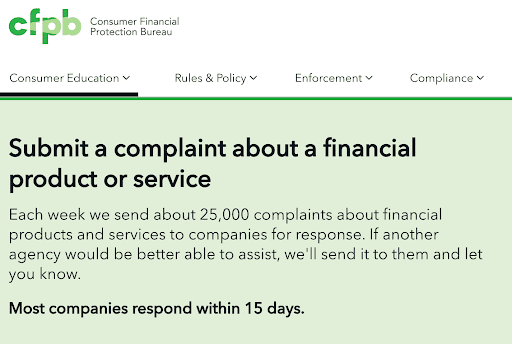
To start :
- Visit the CFPB Complaint Page.
- Scroll down and select “Start a new complaint”.
- Create a user account on the CFPB, if you do not have one.
- Submit a student loan complaint to the CFPB, including the problem, resolution attempts, and supporting documentation.
- Wait for treatment. You should receive a response within 15 to 60 days.
- Review the company’s response. You will be notified when it is available and can submit feedback for up to 60 days.
3. Get help from a member of Congress
If you still feel like you’re getting nowhere, contact your local congressman through something called “constituent services.” Through Constituent Services, a Member of Congress works on your behalf to help resolve your student loan grievance and provide you with references and information about your case.
To get started, go to your local manager’s website to submit a support request. For example, Vermont residents can get help from Senator Bernie Sanders by fill out an application form. California residents can contact Senator Alex Padilla and submit an application online.
To find the official website, you can search (your state + constituent departments) or go to your senator’s official government website.
Preventive measures and best practices in the event of student loan disputes
No one wants to settle a student loan dispute because it can be time-consuming and frustrating. To help you avoid problems in the future:
- Create a student loan file with all important documents.
- Once a month, review your student loan account after your payment is made.
- Check credit report errors at least once a year or more.
- Sign up to receive text or email alerts.
- Immediately update your mailing address, email, and phone number if it changes.
- Make copies of all forms you submit.
These preventative measures can help you avoid student loan disputes in the future and stay organized. Additionally, it is important to know your rights and responsibilities as a student loan borrower.
Nineteen states have adopted a Student Borrower Bill of Rightsand other states are expected to follow. These protections are intended to set standards, prohibit abusive practices, and require transparency for student loan borrowers.
It’s also a good idea to review your master promissory note to understand the terms and conditions of your student loans. This agreement outlines your legal responsibilities and can help you understand whether or not your student loan dispute is valid.
Get help
Disputing student loans with your servicer can be a stressful and discouraging experience. Following the steps above can help you try to get to a resolution faster.
If you want even more support with your repayment strategy, in general, Student Loan Planner can help. We offer a personalized student loan plan that outlines the next steps for you and your unique financial and life goals. Book a consultation today.